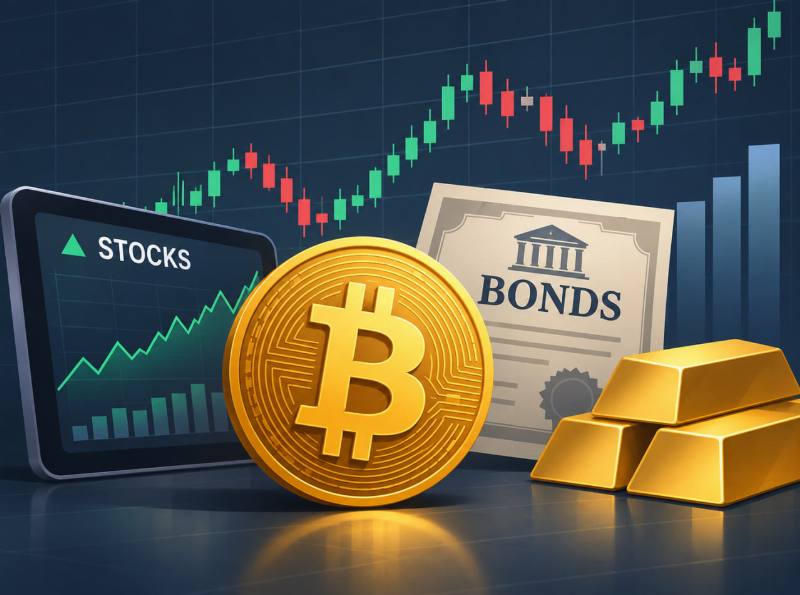
- Bitcoin compounded at roughly twice the pace of US equity ETFs since mid-2020.
- Gold finished third, ahead of listed real estate and bonds.
- The broad US bond market fund was the only benchmark to lose money.
- November’s selloff shows the price swings that came with Bitcoin’s lead.
Bitcoin returned about 29% a year between August 10, 2020 and November 20, 2026, roughly double the annualized gains of the exchange-traded funds that track the Nasdaq-100 and the S&P 500, according to a historical comparison of six major benchmarks. The gap held even though Bitcoin fell 5.01% on November 20 to close at $58,799.
Bitcoin at 29%, Bonds Below Zero
The comparison measures Bitcoin against five funds that investors commonly use as proxies for the main asset classes: Invesco’s QQQ for large US technology and growth companies, SPY for the S&P 500, GLD for physical gold, VNQ for listed US real estate and BND for the US investment-grade bond market. Bitcoin finished about 15 percentage points ahead of QQQ and 16 points ahead of SPY, while gold came third with roughly 9% a year. The rates are rounded and come from one historical comparison that has not been rebuilt on identical dates for every fund, so gaps of a point or two between them should not be read too precisely.
| Asset (ticker) | Annualized return | $10,000 became |
|---|---|---|
| Bitcoin (BTC) | +29% | $49,462 |
| Nasdaq-100 (QQQ) | +14% | $22,764 |
| S&P 500 (SPY) | +13% | $21,539 |
| Gold (GLD) | +9% | $17,177 |
| US real estate (VNQ) | +5% | $13,584 |
| US bonds (BND) | -0.57% | $9,647 |
Aug. 10, 2020 to Nov. 20, 2026; rounded rates, before taxes and fees.
An annualized return is the steady yearly rate that would turn the starting value into the ending value, so it says nothing about how bumpy the path was. Bitcoin’s 29% includes the 2022 bear market, when the price fell from a peak near $69,000 in November 2021 to below $16,000 a year later, and an investor who sold during that slump would have missed most of the gain shown above.
Spot ETFs and the Halving Changed Who Buys Bitcoin
The comparison starts at about $11,900 per coin, in the middle of the pandemic, when central banks had pushed interest rates close to zero and flooded markets with cash. Two later events changed who buys Bitcoin, starting in January 2024, when the US approved spot Bitcoin exchange-traded products, which let financial advisers and brokerage clients buy exposure in the same accounts they use for QQQ, without handling wallets or private keys. Three months later the April 2024 halving cut the reward that miners receive for each new block from 6.25 BTC to 3.125 BTC, halving the pace at which new coins enter the market. Lower supply raises the price only if demand holds up, which is why the halving works as a condition for growth and offers no guarantee of it.
Why the Bond Fund Lost Money
BND lost money mainly because of its starting point, since in August 2020 US bond yields sat near record lows, and when inflation surged the Federal Reserve began raising rates aggressively in 2022. Existing bonds paying the old, lower interest became less attractive, so their market prices fell, and the fund’s interest income was not enough to offset that loss over six years. Rising rates also hurt VNQ, as higher borrowing costs lowered property valuations and office occupancy weakened, and because the fund holds listed real estate companies its 5% says little about what a house or apartment earned over the same period.
November Shows What the 29% Cost
On November 20, according to Yahoo Finance daily data, QQQ fell 5.67% to $608.45, a steeper drop than Bitcoin’s, while SPY lost 3.64% to $689.81. Bitcoin then touched $55,150 on November 21 before closing November 22 at $61,162. Arthur Hayes, the BitMEX co-founder who now serves as chief investment officer of Maelstrom, said on November 23 that Bitcoin could return to $55,000 if Nasdaq futures keep sliding, a view that treats the two markets as tightly linked in the short run even though their six-year results are far apart.
Q’s are rolling over in Asia morning session, let’s run it back turbo and retest $55k on $BTC pic.twitter.com/GABhomFMBD
— Arthur Hayes (@CryptoHayes) November 23, 2026
Start Date Decides the Winner
Measured from August 2020, even a lower Bitcoin price would keep it on top, since the annualized figure would drop to about 27.6% at $55,000 and about 25.7% at $50,000. Someone who bought at the October 2025 record of $126,080 is a different case, sitting on a loss of roughly 53% at the November 20 close. The equity and bond funds also paid dividends and interest along the way, so a full total-return comparison needs those payments reinvested, and none of the figures above adjust for inflation.
Investors who want to test other start dates can rebuild the comparison with dividends reinvested on independent tools such as Total Real Returns, which confirms the method behind these figures but not the exact six-year rates. Moving the start from August 2020 to January 2024, the month spot Bitcoin ETFs began trading, is the most direct way to see how much of Bitcoin’s lead depends on the pandemic-era starting price and how much came after the asset entered mainstream brokerage accounts.